At 28°C, most of us would probably describe the weather as warm.
In an office, though, 28°C can mean something quite different.
The Office for National Statistics uses 28°C as the threshold for a “hot day” in its analysis of how temperature affects productivity across Great Britain.
Its research estimated that hot days between 1998 and 2021 were associated with £28.6 billion in lost economic output; an average of around £1.2 billion a year.
In 2020 alone, the modelled impact reached £5.3 billion.
These figures are estimates, rather than a direct measure of what individual businesses lost. Even so, they raise a useful question:
How well are our workplaces equipped for hotter days?
British summers are changing
This isn’t just about one unusually warm summer.
The Met Office confirmed that 2025 was the UK’s warmest summer on record. And by 15 July this year, the UK had already experienced more days above 30°C than during the whole summer of 1976.
For workplaces, that changes the conversation around cooling.
The Financial Times has also reported that repeated heatwaves are shifting expectations in the office market. Air conditioning is increasingly being viewed as a necessity rather than a luxury, while buildings without adequate cooling risk becoming less attractive to tenants.
In other words, what people expect from an office is changing along with the weather.
Expectations are changing at home too
Perhaps one of the clearest signs of that shift is what’s happening at home.
Around 4 million UK homes now have air conditioning, twice as many as three years ago.
People are increasingly looking for it when choosing where to live, too. During this summer’s hot weather, searches for UK homes with air conditioning more than doubled compared with the previous year.
That creates an interesting challenge for employers.
If someone can work comfortably from home during a heatwave, the prospect of travelling into an excessively hot office becomes considerably less appealing.

Is AC becoming part of a modern office?
We already expect a good office to provide reliable internet, appropriate lighting and comfortable furniture.
Perhaps temperature control now belongs on that list.
The Health and Safety Executive doesn’t specify a maximum workplace temperature, but employers are required to provide a reasonable indoor temperature and assess the risks associated with excessive heat.
Of course, air conditioning isn’t the only answer. Good ventilation, shading and other measures can all help, while retrofitting older buildings with cooling systems isn’t always straightforward.
But for businesses comparing office space, a few questions are becoming increasingly relevant:
Does it have air conditioning?
Can we control the temperature properly?
Will meeting rooms stay comfortable when they’re full?
What happens when the next heatwave arrives?
These might once have been fairly minor considerations.
They’re becoming much harder to ignore.
What we’ve seen at Flexworks
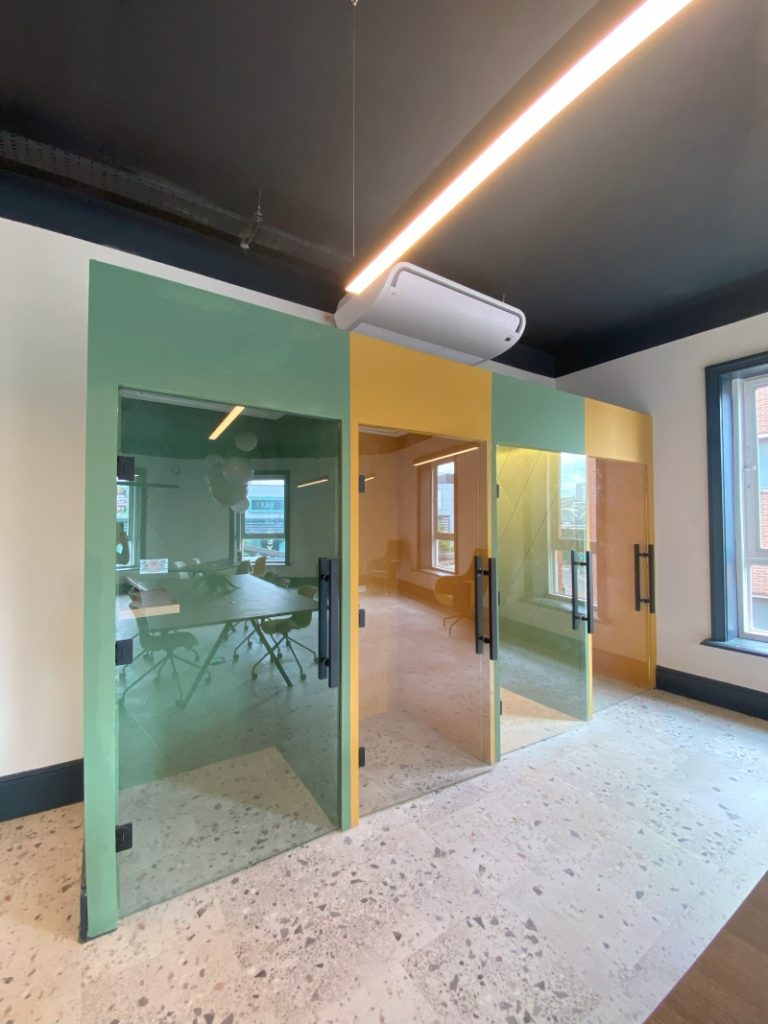
When we developed Flexworks in Hull, air conditioning was included in the specification for our premium private offices.
The system was designed and installed by Hull-based air-conditioning specialist RYL. It formed part of a wider approach to the working environment, alongside the things we also considered important to getting the space right — lighting, acoustics, connectivity and design.
Andy from RYL stated: “When we designed the system for Flexworks, the aim was to provide effective temperature control while making sure the installation worked with both the design and day-to-day use of the building. With hotter summers becoming more common, cooling is increasingly something businesses need to consider when specifying modern office space.”
At the time, air conditioning was simply one part of the overall specification.
After the summers we’re now experiencing, it feels considerably more important.
Businesses shouldn’t choose an office simply because it has air conditioning. There are plenty of other things that make a workspace somewhere people actually want to work.
But as Britain’s summers change, perhaps businesses should be asking a little more often why an office doesn’t have it.
Sources
Financial Times — UK office air conditioning and changing tenant expectations
The Guardian — economic impact of UK heatwaves
The Guardian — growth in domestic air-conditioning installations
Health and Safety Executive — workplace temperature guidance